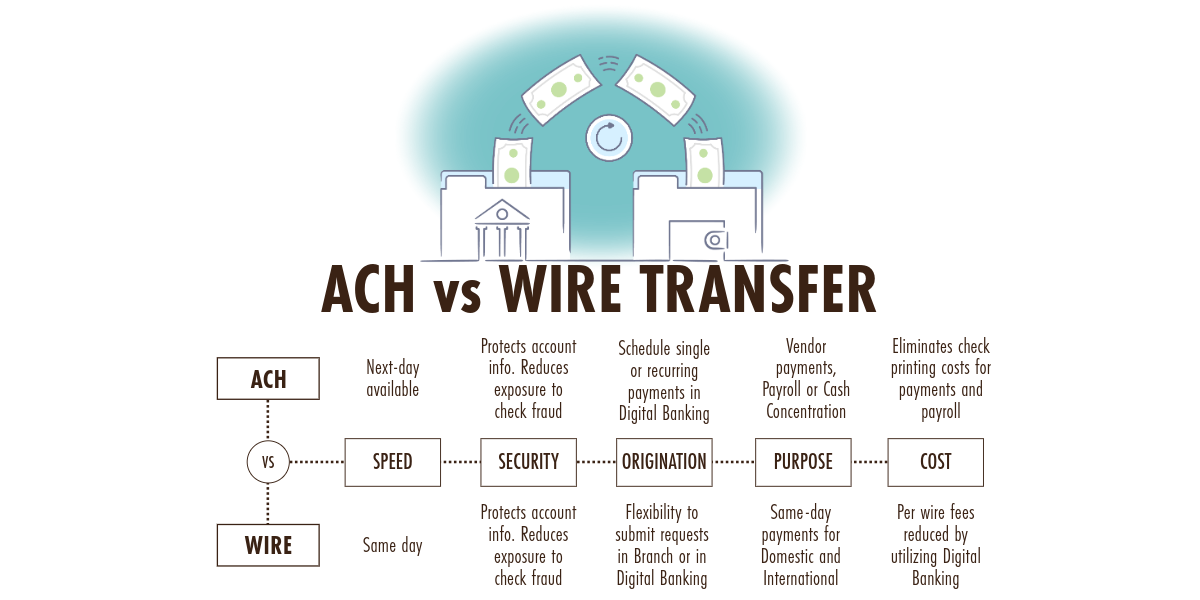
Two popular methods for transferring funds are Automated Clearing House (ACH) transfers and wire transfers. Both are efficient in their own rights but serve different needs and operate under different mechanisms. The choice between ACH and wire transfers largely depends on the nature of the transaction:
- Cost Sensitivity: For regular, less urgent transactions that don’t require immediate settlement, ACH is typically more suitable due to its lower cost.
- Urgency and Reach: If the transaction is urgent, particularly if it needs to cross international borders, a wire transfer may be the preferable option despite its higher cost.
- Transaction Size: For large transactions, particularly in a business context, wire transfers might be more beneficial due to their immediate processing and additional security measures.
ACH transfers are a form of electronic fund transfer (EFT) that moves money between banks or financial institutions within the United States. Managed by the National Automated Clearing House Association (NACHA), this method relies on a centralized system that processes transactions in batches. ACH transfers are commonly used for direct deposit payroll, recurring loan payments, and monthly utility bills.
- Cost-effective: Generally, ACH fees are lower compared to wire transfers, making them a cost-efficient option especially for regular, small transactions.
- Convenience: ACH allows for both one-time and recurring transactions. It's particularly convenient for routine payments like mortgages or rent.
- Safety: ACH transfers are considered safe as they are regulated by NACHA and require strict authentication processes.
- Speed: ACH transactions can take 1-3 business days to process because they are batch-processed.
Wire transfers, on the other hand, are a method for transferring funds directly and quickly between two financial institutions. This can be done domestically or internationally. Unlike ACH transfers, wire transfers are processed in real-time, which means they can be completed within hours.
-
Speed: Funds transferred via wire can be available within the same day, which is ideal for urgent or time-sensitive transactions.
Global Reach: Wire transfers can be made internationally, making them essential for global business transactions or overseas payments. - Security: Although expensive, the fast nature of wires, combined with verification steps, adds a layer of security to high-value transactions.
- Cost: Wires are generally more expensive than ACH transfers. Both the sender and recipient can incur fees.
- Irreversible: Once a wire transfer is processed, it cannot be reversed. This feature requires users to double-check the recipient's details before sending.
The choice between ACH and wire transfers largely depends on the nature of the transaction:
- Cost Sensitivity: For regular, less urgent transactions that don’t require immediate settlement, ACH is typically more suitable due to its lower cost.
- Urgency and Reach: If the transaction is urgent, particularly if it needs to cross international borders, a wire transfer may be the preferable option despite its higher cost.
- Transaction Size: For large transactions, particularly in a business context, wire transfers might be more beneficial due to their immediate processing and additional security measures.